Credit spreads explained: How they work, where the risk is, and why I like them
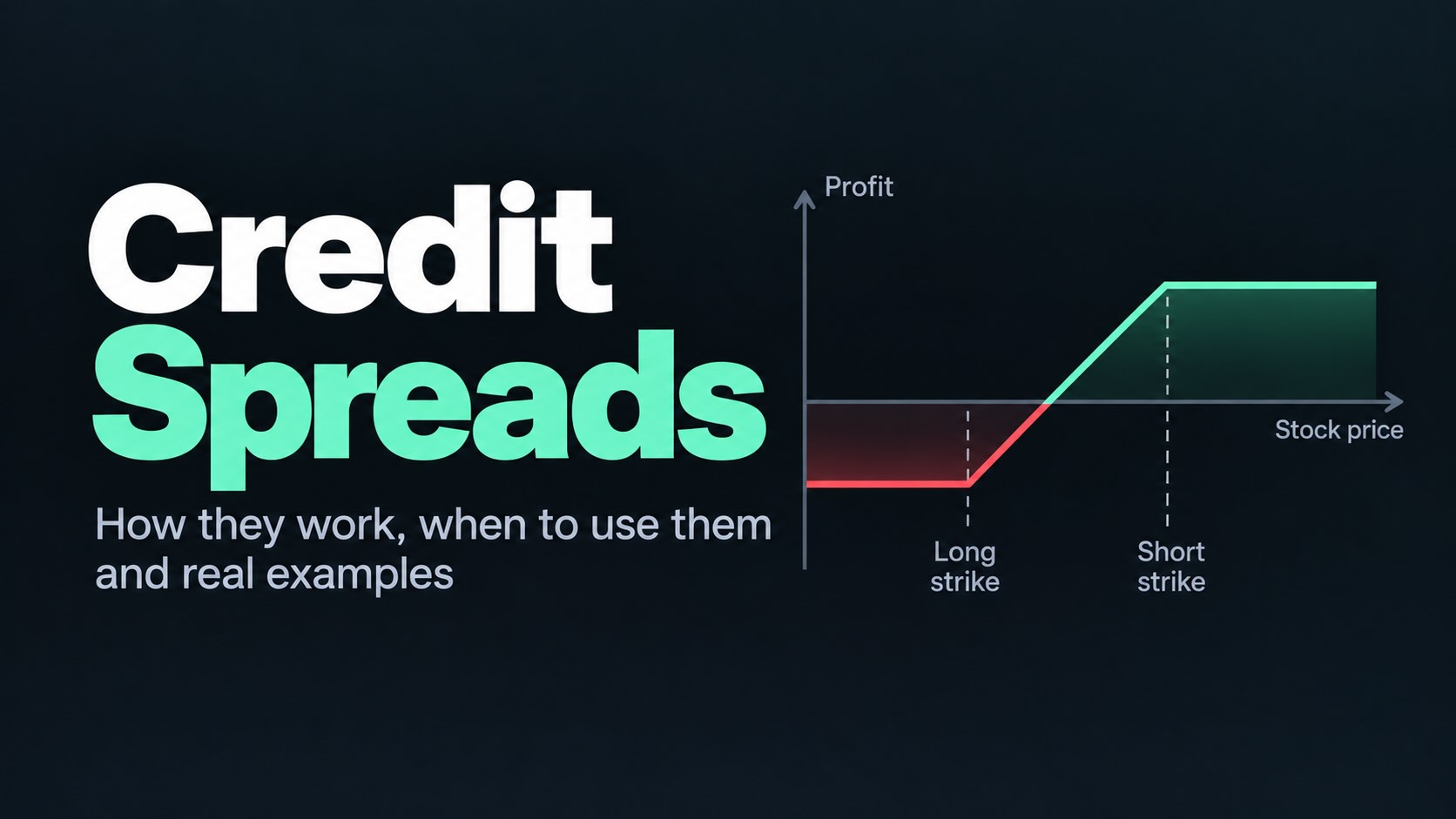
Credit spreads are one of the option strategies I keep coming back to because the risk is defined before I enter the trade. I know the maximum profit, the maximum loss and the price where the position starts losing money. That doesn't make them safe, but it does make the trade easier to understand. In this article, I'll go through how credit spreads work, the difference between bullish and bearish spreads, and the parts I think matter most when deciding whether a trade is worth taking.
What a credit spread is
A credit spread is built by selling one option and buying another option of the same type with the same expiration date. The option I sell is more expensive than the option I buy, so I receive money when I open the trade.
That's where the word "credit" comes from. Money is credited to the account when the position is opened.
The option I buy has another job though. It limits how much the position can lose.
Without that long option, selling a put or call can expose me to much larger losses. With the spread, the distance between the strikes gives me a defined maximum risk.
There are two common versions:
Bull put credit spread
Bear call credit spread
The bull put spread is bullish. The bear call spread is bearish.
The structure is almost the same in both cases. I'm selling a more valuable option and buying a cheaper one further away.
A simple bull put credit spread
Let's say a stock is trading at $100 and I think it will stay above $95 during the next week.
I could sell a $95 put and buy a $90 put:
Sell 95 put for $1.50
Buy 90 put for $0.50

Net credit = $1.00
Stock options normally represent 100 shares, so a $1.00 credit means I receive $100 when I open one spread.
The spread is $5 wide:
95 - 90 = 5The maximum profit is the premium I received:
max_profit = 1.00 * 100

# $100
The maximum loss is the width of the spread minus the credit:
spread_width = 5.00
credit = 1.00

max_loss = (
    spread_width - credit
) * 100

# $400
So I'm risking $400 to make $100.
At first glance, that can look like a terrible trade. Why would I risk $400 to make $100?
The answer is that risk/reward doesn't tell me how likely each outcome is. A credit spread is often placed out of the money, so the underlying doesn't necessarily have to move in my direction. It can go up, stay flat or sometimes even move against me a little and the trade can still finish profitable.
The break-even price
For a bull put spread, the break-even price is the short put strike minus the credit received.
Using the example above:
short_put = 95
credit = 1.00

breakeven = short_put - credit

# $94.00
The stock started at $100, but it doesn't have to stay above $100. It doesn't even have to stay above my short strike for every second of the trade.
At expiration, the position breaks even around $94.
If the stock finishes at $97, both puts expire worthless and I keep the entire $100 credit. If it finishes at $94, the spread is worth roughly $1, which cancels out the $1 credit I originally received.
If it finishes below $90, both options are fully in the money and the spread reaches its maximum value of $5. That's where the maximum loss occurs.
Why I like the shape of a bull put spread
A normal long call usually needs the underlying to move upward enough to overcome the premium I paid. A bull put spread can work differently.
If I sell puts below the current market price, the stock has some room to move against me before the trade reaches the break-even point.
For example:
Stock price: $100
Short put:   $95
Long put:    $90
Credit:      $1

Break-even:  $94
The stock could fall from $100 to $96 and I could still make the full profit if it stays above $95 at expiration.
That's one of the reasons I find credit spreads interesting. I don't always need to predict a large move. Sometimes I'm making a much simpler bet: I don't think the price will fall below this level before expiration.
The bearish version: a bear call spread
If I think the underlying will stay below a certain price, I can build the same type of trade with calls.
Imagine the stock is trading at $100 and I don't think it will move above $105.
I could open:
Sell 105 call for $1.50
Buy 110 call for $0.50

Net credit = $1.00
Again, the maximum profit is $100 and the maximum loss is $400.
The break-even calculation changes because this time I'm using calls:
short_call = 105
credit = 1.00

breakeven = short_call + credit

# $106.00
If the stock finishes below $105, both calls can expire worthless and I keep the full credit.
If it finishes above $110, the spread reaches maximum loss.
The two strategies are basically mirror images:
Bull put spread:
I want the price to stay above my short put.

Bear call spread:
I want the price to stay below my short call.
The long option is what defines the risk
This is the part I think makes spreads attractive for smaller accounts.
If I sell a put by itself, I could be obligated to buy 100 shares at the strike price. A $100 strike means potentially buying $10,000 worth of stock.
With a bull put spread, the lower put limits the loss.
For example, selling a $95 put and buying a $90 put gives me a maximum spread value of $5. It doesn't matter if the stock falls to $80, $50 or zero at expiration. The difference between the two strikes is still $5.
The premium reduces that maximum loss further.
That doesn't mean the loss is small. A $5-wide spread can still risk several hundred dollars per contract. The important part is that I can calculate that amount before I enter.
Spread width changes the trade
The distance between the two strikes has a large effect on the position.
Imagine I sell the $95 put again.
I could buy the $94 put and create a $1-wide spread:
Sell 95 put
Buy 94 put
Or buy the $90 put and create a $5-wide spread:
Sell 95 put
Buy 90 put
The wider spread will usually collect more premium because the long option is further away and therefore cheaper. But the maximum loss is also larger.
A narrow spread makes it easier to keep the dollar risk small, which can be useful on a smaller account. The trade-off is that fees and bid/ask spreads can become a bigger percentage of the potential profit.
I don't think wider is automatically better or worse. I want the width to fit the account and the amount I'm willing to risk.
The credit matters more than the premium looks
Suppose I see two $5-wide spreads.
The first pays $0.20:
max_profit = $20
max_loss = $480
The second pays $1.00:
max_profit = $100
max_loss = $400
They have the same width, but the second trade has a completely different risk/reward profile.
That still doesn't make the $1.00 spread automatically better. The higher premium usually exists because the market sees more risk. Maybe the short strike is closer to the current price, volatility is higher or an important event is coming.
I don't want to choose a spread by sorting for the biggest credit. The premium is compensation for taking risk, not free money.
Delta can help me choose the short strike
One way to choose the short strike is by looking at delta.
For an out-of-the-money put, a delta around -0.20 is sometimes used as a rough indication that the option has about a 20% chance of finishing in the money. It isn't a guarantee and delta isn't literally a probability calculator, but it can be a useful shortcut when comparing strikes.
A short put with a smaller absolute delta will normally be further away from the current stock price and collect less premium.
For example:
-0.10 delta:
Further away
Lower premium
More distance from the current price

-0.30 delta:
Closer to the price
Higher premium
Less room for the trade to be wrong
I don't want delta to make the whole decision for me. I also look at the chart, recent volatility, support levels and whether an event such as earnings is coming before expiration.
Time helps credit spreads, but not in a straight line
When I sell an option, time decay is generally working in my favor. All else being equal, an option loses time value as expiration approaches.
That is one of the basic ideas behind a credit spread. I sell the more expensive option and buy a cheaper one, leaving me with positive net premium.
But both options in the spread are losing time value. I'm not simply collecting the full theta from the short option.
The position value is determined by the difference between the two options:
spread_value = (
    short_option_value
    - long_option_value
)
What I want is for that difference to shrink after I open the trade.
If I sold the spread for $1.00 and can later buy it back for $0.40, I keep $0.60 of the original credit.
I don't need to hold until expiration
This was something I didn't properly appreciate when I first started looking at credit spreads.
If I receive $100 of maximum credit, I don't have to hold the trade until the options expire to make money.
Suppose I sell the spread for:
$1.00 creditA few days later, the underlying has moved in my favor and the spread is trading for:
$0.30I can buy it back and close the entire position.
credit_received = 1.00
closing_cost = 0.30

profit = (
    credit_received - closing_cost
) * 100

# $70 before fees
I've collected 70% of the maximum possible profit without waiting for expiration.
Whether that makes sense depends on how much time is left and how much risk remains. If there are still three weeks left and I've already made most of the available profit, I might prefer freeing the capital rather than continuing to risk a large loss for the last few dollars.
The risk/reward can look uncomfortable
Credit spreads often have a risk/reward ratio that looks bad compared with trades where I risk $1 to make $2 or $3.
Maybe I risk $400 to make $100.
That's a 4:1 ratio in the wrong direction if I look only at dollars.
The missing part is how often I expect to win.
A spread placed well out of the money can have a relatively high probability of expiring profitably. That doesn't mean the strategy is automatically profitable, because a single full loss can wipe out several winners.
If I make $100 four times and then lose $400 once, I'm back at zero before fees:
wins = 4 * 100
losses = 1 * 400

result = wins - losses

# $0
This is why I don't want to judge a credit-spread strategy from win rate alone. A strategy that wins 80% of the time can still lose money if the losing trades are much larger than the winners.
Maximum loss still matters even if I plan to exit early
I can have a rule where I close a spread before it reaches maximum loss. Maybe I exit when the underlying breaks my short strike, when the spread doubles in value or when a chart level fails.
That can reduce losses during normal market conditions.
But I still want to size the trade based on the fact that maximum loss is possible.
A stock or index can gap through my planned exit. Options can become illiquid. A limit order might not fill where I expect.
If the maximum loss would seriously damage the account, I don't want to convince myself that my stop makes that maximum loss impossible.
Expiration changes the character of the trade
A credit spread with 45 days until expiration behaves very differently from one that expires this afternoon.
With more time, the underlying has more time to move against me, but I also have more time to manage the trade. The price of the spread usually reacts more gradually to small movements in the underlying.
Very short-dated spreads can change value extremely quickly near expiration. If the underlying gets close to the short strike, the position can go from comfortable to uncomfortable in a short period of time.
The premium can look attractive because time is disappearing quickly, but the trade also gives me very little time to be wrong.
I don't think 0DTE or 1DTE spreads are automatically bad, but I don't want to treat them as smaller versions of a 30- or 45-day trade. The management is different.
Credit spreads also have assignment risk
With stock and ETF options, the short option can be assigned before expiration.
For a bull put spread, assignment on the short put means I can be obligated to buy 100 shares at the short strike. I still own the long put, so the overall position has protection, but the account can temporarily look very different from the clean two-leg spread I originally opened.
This is one reason I want to understand what the broker will do before holding short options close to expiration, especially when they are in the money.
Cash-settled index options work differently because there are no shares to deliver. That's one reason products such as SPX can behave differently operationally from something like SPY even when the option strategies look almost identical on the screen.
Fees matter on small spreads
If I collect $20 on a trade and pay several dollars in commissions and exchange fees, the cost is a meaningful percentage of the maximum profit.
This matters even more if I open and close several contracts.
For example, suppose the theoretical profit is $25 and the total fees are $4:
gross_profit = 25
fees = 4

net_profit = gross_profit - fees

# $21
That's 16% of the gross profit gone to fees.
I don't think that means small spreads are unusable. It means I want to calculate the return after fees instead of looking only at the premium shown in the option chain.
Liquidity matters too
Options have a bid and an ask price. If the spread between them is wide, the price shown in the middle can make the trade look better than the price I can actually get.
Imagine the spread is quoted:
Bid: $0.60
Ask: $0.90

Mid: $0.75
The platform might show $0.75 as the theoretical value, but that doesn't mean someone is willing to fill my order there.
If I enter for less credit than expected and later have to pay more than expected to close, that difference eats into the edge of the trade.
I prefer underlyings with active option markets because tighter spreads make entering and exiting much easier.
What happens when the underlying approaches the short strike?
This is where a comfortable credit spread starts becoming much more interesting.
Suppose I have:
Stock: $100

Short put: $95
Long put:  $90
The stock falls to $96.
I'm still above the short strike, but the spread will probably be worth considerably more than when I opened it. The market now sees a much larger chance that the short put finishes in the money.
I have several choices. I can close the trade and accept the loss. I can continue holding because the original setup is still valid. Depending on the strategy and liquidity, I might also roll the position to different strikes or another expiration.
What I don't want to do is wait until the stock reaches $95 and then start deciding what my plan is.
I want that decision made before entering the trade.
Rolling isn't the same as removing the loss
Rolling a spread usually means closing the current position and opening another one, often at a later expiration or different strikes.
It can be useful, but I think the language can make it sound more magical than it is.
If I close a losing spread for a loss and open a new spread for a credit, the original loss still happened. I've opened a new trade that might recover some or all of it.
I want to evaluate the new position on its own:
Would I open this new spread
if I didn't already have the old one?
If the answer is no, rolling it only because I don't want to book a loss probably isn't a great reason.
Position sizing matters more than finding the perfect strike
I can spend a lot of time choosing between a -0.18 delta and a -0.22 delta short put. That difference matters, but I think the size of the position matters more.
A good setup can still hurt badly if I put too much of the account into it.
Imagine a spread has a maximum loss of $450.
On a $50,000 account:
450 / 50000 = 0.009

# 0.9% of the account
On a $3,000 account:
450 / 3000 = 0.15

# 15% of the account
It's the exact same trade, but the risk is completely different.
This is one of the lessons I'm trying to keep in mind with The Trading Quest. Defined risk is useful, but "defined" doesn't mean "small".
Why I currently prefer defined-risk spreads
I understand why some traders prefer cash-secured puts. If they genuinely want to own 100 shares of a company, selling a put can be a logical way to potentially enter the position while collecting premium.
For a smaller account, that can require a lot of capital. A $50 stock needs $5,000 to fully cash-secure one put contract.
A spread lets me define a smaller amount of capital at risk by buying the protective option.
The trade-off is that I collect less premium because I have to pay for that protection. I also introduce another option leg, more fees and more complexity.
For what I'm doing right now, I like knowing the maximum loss before I enter. It makes position sizing much easier.
What I look at before opening a credit spread
I don't want the decision to start with the option chain. First I want an opinion about the underlying.
For a bull put spread, I want a reason to believe the underlying will stay above a certain area. That might be an uptrend, a support level or simply enough distance between the current price and my short strike.
Then I look at the options. I want enough liquidity that I can enter and exit without fighting a huge bid/ask spread. I look at delta to understand how far away the strike is, check the credit against the maximum loss and look at how much time is left before expiration.
I also want to know what's happening before expiration. Earnings, major economic releases and other scheduled events can change option prices very quickly.
Finally, I calculate the actual account risk.
spread_width = 5
credit = 0.50
contracts = 1

max_loss = (
    spread_width - credit
) * 100 * contracts

# $450
If I'm not comfortable losing that amount, the trade is too large regardless of how good the chart looks.
The trade should have an exit plan before I enter
I don't think every credit spread needs the same take-profit or stop-loss rule.
A longer-dated spread might make sense to close after I've captured 50% or 70% of the available premium. A very short-dated spread can behave completely differently.
What matters to me is knowing what I'm planning to do before the position becomes stressful.
I want answers to a few questions. How much of the credit am I trying to keep? What price movement would tell me the original setup is wrong? Am I willing to hold through expiration? Is there an event coming that I don't want exposure to?
If the first time I answer those questions is after the trade moves against me, I'm making the plan at the worst possible time.
Credit spreads are simple, but managing them isn't always simple
The basic calculation is easy. Sell one option, buy another, collect the difference and define the maximum risk.
The more difficult part is choosing a spread where the premium is worth the risk, sizing it correctly and deciding what to do when the underlying moves toward the short strike.
I like credit spreads because I can see the boundaries of the trade before opening it. I know the maximum profit, maximum loss and break-even price, and I can decide whether those numbers fit the account.
That still leaves plenty of ways to get it wrong. I can choose a bad underlying, trade too close to expiration, sell too close to the current price, ignore an upcoming event or simply risk too much.
For me, the defined risk is the starting point. The real work is making sure the amount I define is an amount I'm actually willing to lose.