Risk management in trading: How I control losses before entering a trade
Finding a good trade is only half the job. Before I enter, I want to know how much I can lose, where the trade is invalidated and what that loss means for the rest of my account. In this article, I'll go through how I think about position sizing, stop losses, risk/reward and the rules I'm trying to follow during The Trading Quest.
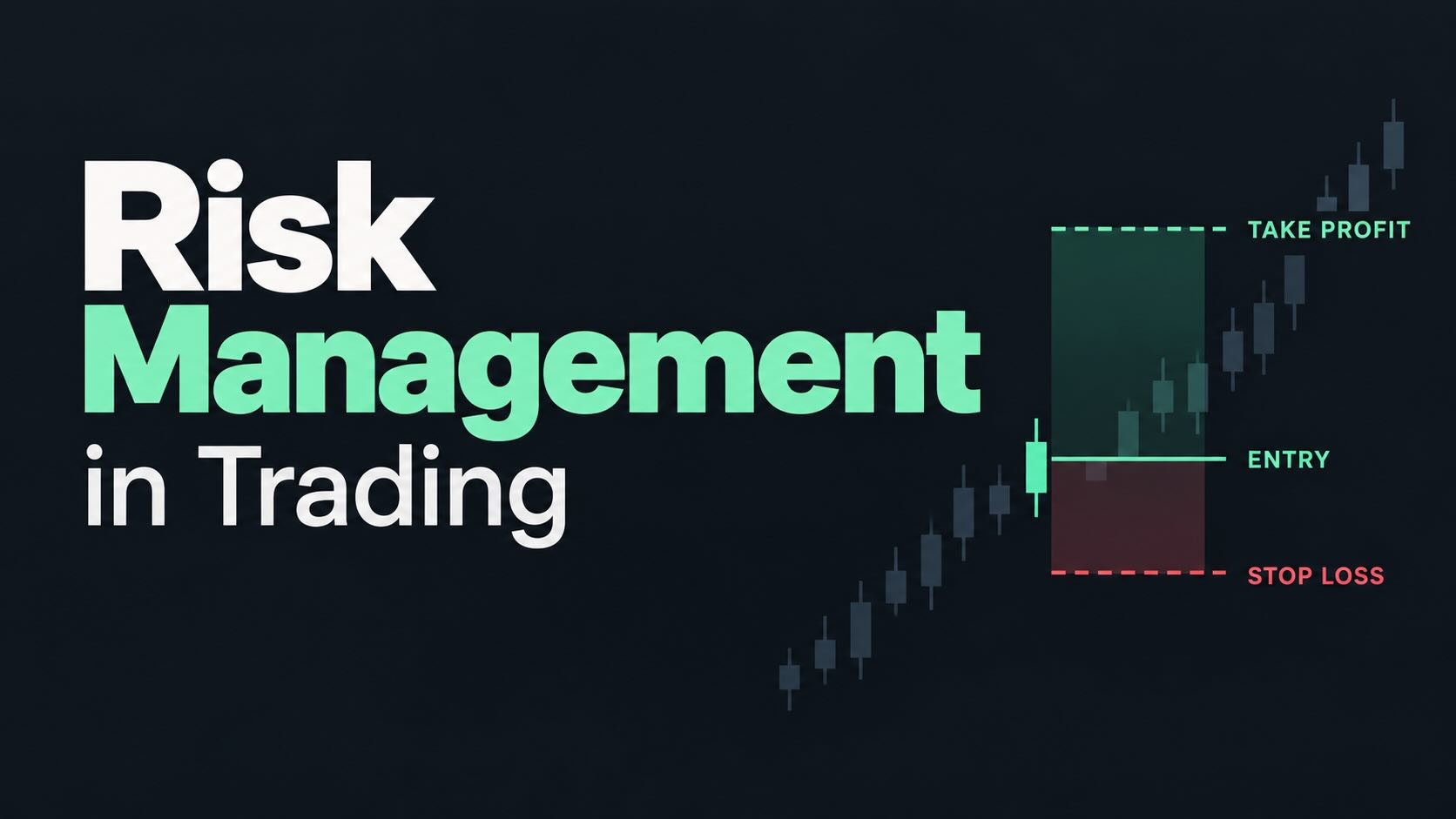
Risk management sounded boring until I started trading
When I first got interested in trading, risk management wasn't exactly the part I wanted to spend time learning. Finding entries, looking at charts and figuring out which stock might move next was much more interesting.
But once real money is involved, the downside becomes difficult to ignore. A strategy can be profitable over hundreds of trades and still destroy an account if I put far too much money into one position. I can also be completely right about a setup over time and still get five losing trades in a row.
That's the part I'm trying to take more seriously during The Trading Quest. I don't want one bad trade, one bad day or one stupid decision to decide the result of the whole experiment.
The way I think about it now is fairly simple. Before entering a trade, I should know where I'm wrong and how much money I'm willing to lose if I'm wrong. Only after that should I work out the position size.
I want to think in account risk, not position size
There is a big difference between putting $500 into a trade and risking $500 on a trade.
If I buy $500 worth of a stock and plan to exit if it falls 3%, my planned loss is around $15. If I buy an option for $500 and I'm prepared to let it expire worthless, I'm actually risking the whole $500.
This is why looking only at how much money I put into a position can be misleading. What I care about is how much of the account I can actually lose.
Let's say my Trading Quest account is $1,000 and I decide that I don't want to risk more than 1% on a normal trade.
account_size = 1000
risk_per_trade = 0.01

max_loss = account_size * risk_per_trade

# $10
That gives me a maximum planned loss of $10.
If I decide to use 2%, the number becomes $20. At 5%, it's $50. The percentage sounds small until I translate it into dollars and imagine losing that amount several times in a row.
Position size comes after the stop
Something I want to avoid is deciding how many shares I want first and then squeezing the stop loss into whatever amount of risk happens to fit.
I think it makes more sense the other way around. First I look at the chart and decide where the trade no longer makes sense. Then I calculate how large the position can be while staying inside my risk limit.
Imagine a stock is trading at $25 and I want to buy it. Based on the setup, I've decided that I don't want to stay in the trade if it falls below $24.50.
I'm risking $0.50 per share.
If my maximum loss is $10:
max_loss = 10
risk_per_share = 0.50

shares = max_loss / risk_per_share

# 20 shares
I can buy 20 shares and my planned loss is approximately $10 if the stop is executed around $24.50.
If the setup needs a much wider stop at $23, I'm risking $2 per share:
max_loss = 10
risk_per_share = 2

shares = max_loss / risk_per_share

# 5 shares
The trade needs more room, so the position gets smaller. I don't move the stop closer simply because I want to own more shares.
There isn't a magic percentage
You'll see people say that you should risk 1% per trade, 2% per trade or some other specific number. I don't think there is one percentage that makes sense for everybody.
An experienced trader with a tested strategy, a large account and hundreds of trades in their journal is in a different situation from somebody experimenting with a strategy for the first time.
The type of trade matters too. I might be comfortable with one level of risk on a diversified long-term position and a completely different level on a short-term options trade that can lose most of its value in a day.
For The Trading Quest, I'm much more interested in finding a risk level I can follow consistently than finding the theoretically perfect percentage. If a single loss makes me angry enough to immediately take another trade to win the money back, I'm probably risking too much.
Small accounts make position sizing difficult
This is one thing that doesn't always come across when people talk about risking 1% per trade.
On a $100,000 account, 1% is $1,000. There are plenty of ways to construct a position with less than $1,000 of risk.
On a $1,000 account, 1% is only $10. That's much harder, especially with options where one contract represents 100 shares and I can't simply buy 0.17 of a contract to make the risk fit perfectly.
A credit spread might have a maximum loss of $80, for example. On a $1,000 account, that's already 8% of the account:
account_size = 1000
max_loss = 80

account_risk = max_loss / account_size

# 0.08 = 8%
That doesn't automatically mean the trade is bad. It means I should be honest about what I'm doing. Calling it a 1% risk strategy doesn't make sense if the smallest position I can open can lose 8% of the account.
Sometimes the correct answer might simply be that a particular strategy doesn't fit the size of the account yet.
Defined risk is one reason I like spreads
This is something I like about vertical option spreads. If I enter a defined-risk spread, I can calculate the maximum loss before placing the trade.
Imagine I sell a $5-wide put credit spread and receive $0.50 in premium. Ignoring fees, the maximum profit is $50 and the maximum loss is $450:
spread_width = 5 * 100
credit_received = 0.50 * 100

max_profit = credit_received
max_loss = spread_width - credit_received

# Max profit: $50
# Max loss: $450
Knowing that number doesn't make the trade safe. It makes the risk visible.
If the account is $10,000, $450 is 4.5%. If the account is $1,000, the exact same position risks 45% of the account. The option chain hasn't changed at all, but the trade looks completely different when I compare it with the account size.
This is one reason I'm trying to look at every trade as a percentage of my account instead of thinking only about the dollar amount of premium I can collect.
Maximum loss isn't necessarily my planned loss
A defined-risk spread might have a maximum possible loss of $450, but that doesn't mean I have to sit there and watch it lose the entire $450.
I can have a point where the original idea is no longer valid and close the trade earlier. Maybe that happens because the underlying breaks a level, the spread reaches a certain loss or something changes in the market.
The distinction I find useful is between maximum loss and planned loss. Maximum loss tells me the worst contractual outcome of the spread. Planned loss tells me where I actually intend to leave if the trade doesn't work.
But I don't want to pretend the planned loss is guaranteed. Markets gap, liquidity disappears and option prices can move quickly. If I'm technically capable of losing $450, I need to be able to handle the possibility that an exit doesn't happen exactly where I hoped.
A stop loss isn't a guarantee
Stops are useful, but I don't want to treat a stop price as if somebody has promised to buy my position at that exact number.
If I own a stock at $100 and place a stop at $95, the stock could close at $97, release terrible news after the market closes and open the next morning at $85. My order can't go back in time and sell the shares at $95.
The same problem can happen during very fast moves while the market is open. Once a normal stop order is triggered, it becomes a market order, so the actual fill can be worse than the stop price.
This affects how I think about position size. If losing slightly more than my planned stop would create a serious problem for the account, the position is probably too large in the first place.
Risk/reward matters, but it doesn't tell me whether a strategy is good
I used to look at a trade with a 1:1 risk/reward ratio and compare it with a trade offering 3:1 and assume the second trade was obviously better.
That leaves out the probability of winning.
Imagine strategy A wins $100 when it works and loses $100 when it doesn't. If it wins 60% of the time over a large sample of similar trades, that can be profitable before costs.
Strategy B might risk $100 to make $300, which looks much better on paper. But if it only wins 20% of the time, the result isn't automatically better.
This is particularly noticeable with credit spreads. I might collect a relatively small premium compared with the maximum loss, but place the short strike far enough away that many trades expire profitably. The lower reward is connected to the higher probability of keeping that reward.
So I still look at risk/reward, but I want to combine it with win rate and actual results from the strategy rather than judge a trade from the ratio alone.
A losing streak should be part of the plan
If I have a strategy with a high win rate, it's easy to start feeling like several losses in a row shouldn't happen. They absolutely can.
If I'm risking 10% of the account on every trade, five full losses in a row can do enormous damage. If I'm risking 2%, the same losing streak is unpleasant, but the account is still very much alive.
This is where percentage losses become interesting. A 10% drawdown requires about an 11.1% gain to recover. If I lose 50% of the account, I need to make 100% on what remains just to get back to where I started.
start = 1000

after_10_percent_loss = 900
gain_needed = (1000 / 900) - 1

# 11.11%


after_50_percent_loss = 500
gain_needed = (1000 / 500) - 1

# 100%
The deeper the hole gets, the harder it becomes to recover. That makes avoiding very large drawdowns much more important to me than squeezing every possible dollar out of a good week.
I also want a limit for the whole day
Position sizing solves the risk of one trade, but it doesn't stop me from taking ten bad trades in the same day.
This is probably more relevant for day trading than long-term investing. If every trade risks $20 and I lose five of them, I've still lost $100 even though every individual trade followed the position-size rule.
So I like the idea of having another limit above the individual trade. If I lose a certain amount during the day, I stop opening new positions.
The number itself isn't what matters most to me. I want a rule that prevents a normal losing day from turning into an emotional trading session where every new trade is really an attempt to recover the previous one.
If I hit that limit, the market will still be there tomorrow.
Several positions can really be one big trade
Another thing I've started paying more attention to is correlation.
Imagine I'm bullish and buy three different technology stocks. On paper I have three separate positions, each risking 2% of the account. It might look like I have diversified the risk.
But if all three stocks tend to move with the Nasdaq and the entire technology sector sells off, they can all lose at the same time. I might effectively have one large bullish technology position split across three tickers.
The same thing can happen with option spreads. Five bullish SPY, QQQ and large-cap technology positions aren't necessarily five independent bets.
I want to look at the total exposure of the account, not only whether each individual trade fits the risk rule by itself.
Averaging down changes the original risk
Adding to a losing position is another place where the numbers can get away from me quickly.
Maybe I buy a stock and plan to risk $20. The stock drops, but instead of exiting I buy more because it's now cheaper. It drops again and I add another time.
I might still be telling myself that the original trade risked $20, but that trade doesn't exist anymore. I changed the position.
There are strategies where adding at lower prices is planned from the beginning, particularly with long-term investing. That's different from improvising because I don't want to accept a loss.
If I plan to scale into a trade, I want the combined position to fit inside the risk limit before I place the first order.
Moving the stop is another easy way to break the plan
Suppose I buy at $100 with a stop at $97. The position size is based on losing $3 per share.
The stock falls to $97.50 and suddenly $97 feels uncomfortably close. I decide the stock probably just needs more room and move the stop to $94.
I haven't only changed the stop. I've doubled the amount I'm willing to lose per share.
If $94 was the correct invalidation point based on the chart, I should probably have used $94 when I calculated the position size before entering. Moving it after the trade moves against me is a very different decision.
I don't mind changing a plan when new information genuinely changes the trade, but "I don't want to take the loss yet" isn't new information.
Fees belong in the calculation too
This matters more with a small account because trading costs take up a larger percentage of the return.
If I make $15 on a spread but pay several dollars to open and close it, the result isn't really $15. The same applies when calculating losses.
I want my journal to track the result after fees, not only the number shown by the trade itself. Otherwise a strategy with lots of small winners can look better on paper than it actually performs in the account.
Bid/ask spreads are another cost that's less obvious. If an option is quoted at $1.00 bid and $1.20 ask, I can't assume I'm going to trade it at the perfect theoretical middle price every time.
The journal should show whether I followed the risk rules
I'm already tracking my trades during The Trading Quest, and I think risk management is one of the most useful things to record.
I want to know the account value when I entered, the maximum possible loss, how much I planned to risk, the percentage of the account at risk and what I actually lost when I closed the trade.
I also want to record whether I broke a rule. Did I increase the size because I was confident? Did I move the stop? Did I hold through an event I hadn't planned for? Did I take another trade because I wanted to recover a loss?
The P/L doesn't tell me all of that. I can break every rule and still make money on a trade. That doesn't turn the decision into a good one.
A profitable trade can still have terrible risk management
I think this is one of the harder parts psychologically.
Imagine I have a $1,000 account and risk $500 on one trade. The trade works and I make $100.
It's very tempting to look at the $100 profit and decide the trade was great.
But if I keep risking half the account, I eventually only need one or two trades to go badly before the experiment is basically over. A good outcome doesn't necessarily mean the amount I risked made sense.
The opposite is also true. I can follow every rule, size a trade properly and lose money. That's still a normal trade if the strategy sometimes loses.
I'm trying to judge the decision separately from the outcome.
How I'm trying to approach risk during The Trading Quest
I don't expect to get every risk rule right immediately. Part of this project is figuring out which strategies work for me, and that includes finding position sizes I can handle without making emotional decisions.
But there are a few questions I want to answer before entering anything. Where am I wrong? How much can I lose? What percentage of the account is that? Can I lose slightly more if the market gaps or the order fills badly? And what happens if the next three trades lose as well?
If I'm uncomfortable with the answers before entering, I doubt I'll become more rational once the position starts moving against me.
I still want to take risks. There isn't much point in running a trading experiment where I'm terrified of every possible loss. But I want those risks to be deliberate.
For me, that's what risk management is becoming. It isn't about avoiding losses, because that's impossible. It's about deciding how expensive being wrong is allowed to be before I click the button.