Day trading vs swing trading vs investing: Which one fits you?
Day trading, swing trading and investing all involve buying something because you think it will be worth more later, but that's about where the similarities end. The amount of time, risk, patience and attention they require is very different. I'm probably going to use all three during The Trading Quest, so I wanted to explain how I think about them and where each one fits.
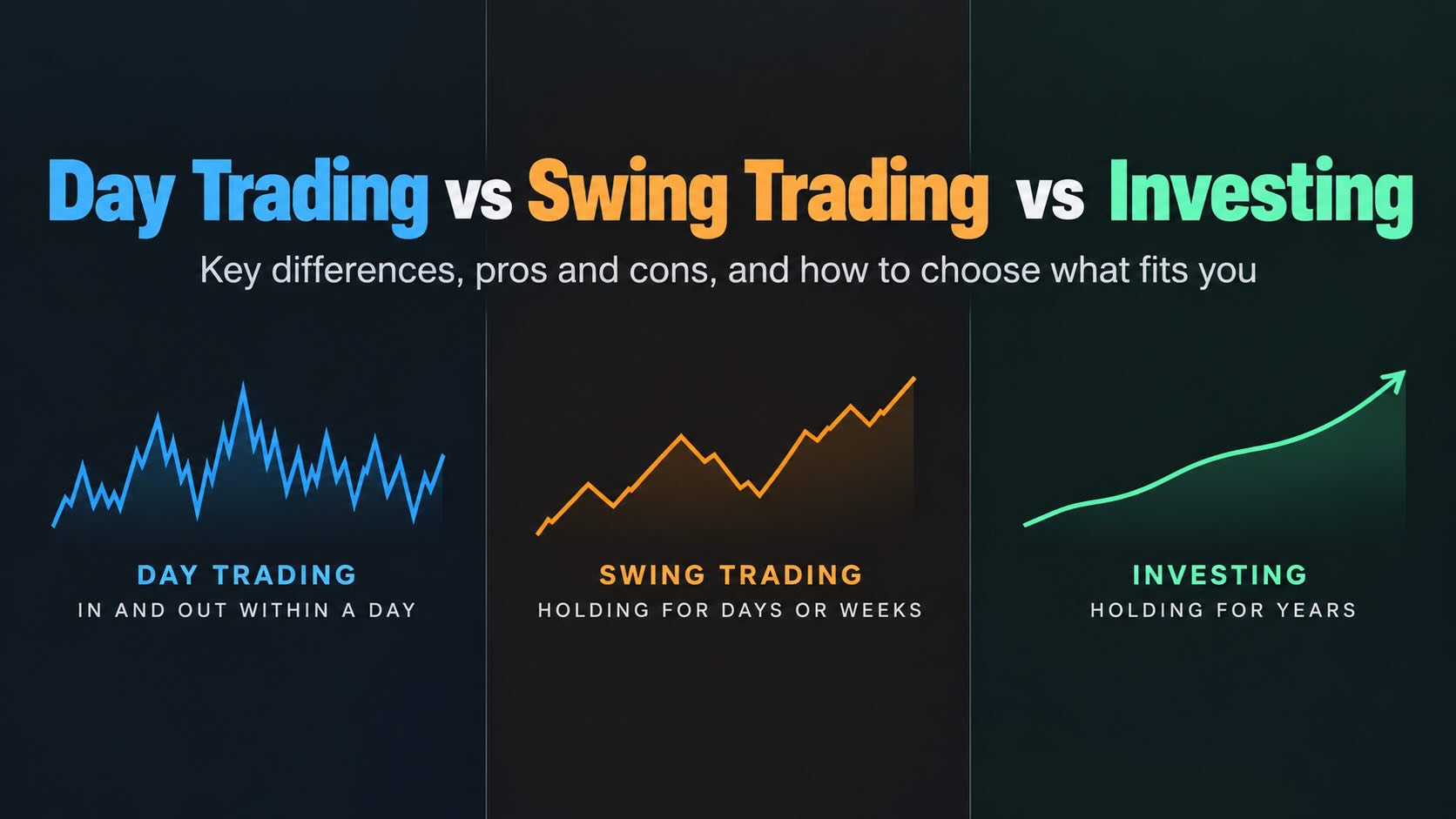
They are three very different ways to make money in the market
Before I started spending more time on trading, I probably looked at all of this as more or less the same thing. You buy a stock, hopefully it goes up, and then you sell it for more than you paid. Simple enough.
But the reason you enter a trade can be completely different depending on whether you are day trading, swing trading or investing. A day trader might buy because a stock broke above a level five minutes ago. A swing trader might buy because the stock has been in an uptrend for two weeks and just pulled back to support. An investor might buy the exact same stock because they think the company will earn much more money five years from now.
The chart can be the same. The stock can be the same. The reason for owning it, how long you plan to hold it and what would make you sell can be completely different.
I think this distinction matters because it's very easy to enter something as a trade and suddenly become a "long-term investor" when the trade goes against you. I've definitely had positions where the original plan changed once the price moved in the wrong direction. That's usually not a very good strategy.
Day trading
Day trading is the shortest of the three. You open and close the position during the same trading day. You might hold something for several hours, or you might be in the position for only a few minutes.
A simple example would be a stock opening at $50, breaking above resistance at $51, and me buying because I think the momentum will continue. Maybe I sell it at $52.20 thirty minutes later. I don't care what the company will earn next year, and I might not even care what the stock does tomorrow. My entire idea was based on what was happening today.
This also means day trading requires much more attention. If my setup is based on a five-minute chart, I can't really open the trade, go grocery shopping for three hours and expect to manage it properly when I get back. The whole trade might have played out before I return.
There is one advantage I really like though: when the market closes, the position is closed too. I don't have to worry about the company releasing terrible news after hours and waking up to a huge gap down the next morning.
That doesn't make day trading safer. It just changes the type of risk. Prices can move very quickly during the trading day, and a strategy that uses leverage or options can make those moves much more painful. Investor.gov describes day trading as extremely risky and warns that substantial losses can happen in a short period of time.
I also think day trading is probably the style where emotions can hurt you the fastest. You can lose a trade at 10:00, get annoyed, enter another trade at 10:05, lose that one as well, increase your position size because you want the money back, and turn a bad morning into a very bad day.
That's one of the reasons I like having rules written down before entering. Where am I entering? Where am I wrong? How much am I willing to lose? If I can't answer those before clicking buy, I probably shouldn't be in the trade.
Swing trading
Swing trading is where I think things become a little more comfortable for someone who doesn't want to sit in front of charts all day. There isn't a universal number of days that makes something a swing trade, but I use the term for trades I expect to hold for several days or perhaps a few weeks.
Maybe a stock has been trending upward for a month. It drops back toward an area that previously acted as support, the overall trend still looks good, and I buy because I expect another move higher over the next week or two.
I don't need the price to move immediately. That's a big difference from many day trades. If the stock moves sideways for the rest of the day, that doesn't necessarily mean my idea was wrong.
It also means I can do most of my analysis before or after the market is open. I can find a setup, place the trade, set alerts and check it a few times during the day instead of watching every candle.
The trade-off is that I have to hold the position overnight. If earnings are released, the market crashes, a CEO resigns or something else happens while the market is closed, the stock can open far away from where it closed the previous day. A stop loss can't guarantee that I'll get out at the exact price I wanted if the stock gaps through it.
I still think swing trading is a nice middle ground. It gives the trade enough time to develop without requiring me to make a prediction about where a company will be five years from now.
For The Trading Quest, I expect swing trades to be a fairly big part of what I do. I have a normal job and other projects, so sitting in front of a one-minute chart for six hours every day isn't realistic. Swing trades are much easier to fit around everything else.
Investing
Investing is the slowest of the three, at least the way I think about it. Here I'm not looking for a move over the next hour or next week. I'm buying because I want to own the asset for a much longer period.
If I buy shares in a company as an investment, the question becomes much more about the business. Is revenue growing? Is the company profitable? How much debt does it have? Does it have some reason to still be stronger several years from now? And perhaps most importantly, am I paying a reasonable price for it?
Short-term price movements matter much less. If I buy at $100 and the stock trades at $94 next week, that doesn't automatically mean anything changed. If the reason I bought the company is still valid, I might do nothing at all.
That's very different from a day trade where a move from $100 to $94 would probably mean something went terribly wrong.
Long-term investing also requires much less screen time. You can build a diversified portfolio, add to it regularly and let time do most of the work. That sounds boring compared with finding the perfect trade on a five-minute chart, but boring isn't necessarily bad when money is involved.
For me, the hardest part of investing is patience. When I have money sitting in an investment and nothing exciting happens for six months, it's very tempting to think I should be doing something. Sometimes doing absolutely nothing is the correct decision.
The time commitment is probably the biggest difference
If I had to choose between these approaches based on one thing, I would look at how much time I can realistically spend on it.
Day trading can almost become a job. You need time to prepare, find setups, watch the market, manage positions and review the trades afterwards. You might only make one or two trades in a day, but that doesn't mean you only spent ten minutes trading.
Swing trading gives you much more freedom. I can check charts in the evening, create a watchlist and then use orders or alerts during the next trading day. I still need to follow my positions, but I don't need to react to every small move.
Investing can take even less day-to-day time once the initial research is done. If I'm buying broad index funds, there might be very little to do at all. If I'm picking individual companies, I still want to follow earnings and understand what is happening with the business, but I'm not watching the stock tick up and down all day.
This is one area where I think people can choose the wrong strategy for their life. Day trading might look exciting, but if you have meetings from 9:00 to 16:00 every day, it probably isn't very practical to depend on intraday setups that require you to react immediately.
The risks aren't the same
All three can lose money, but the way you get into trouble is different.
With day trading, I worry about fast decisions, overtrading, leverage and losing discipline after a bad trade. A few poor decisions can happen very quickly because you get another opportunity every few minutes.
With swing trading, overnight risk becomes more important. I might have a perfectly reasonable stop at $95, but if the company announces something terrible and opens at $88, I'm not magically getting out at $95.
With long-term investing, I think one of the dangers is becoming too attached to the story. A company can be a great investment when I buy it and a terrible investment three years later. Holding for the long term doesn't mean I have to hold forever while the business falls apart.
There's also a difference between volatility and actual risk. A good company dropping 10% during a market correction can look scary, but it isn't necessarily the same as a speculative company losing 10% because its business is getting worse.
The timeframe changes how I interpret the exact same price movement.
The expected return shouldn't be the only reason you choose
I think it's easy to look at trading and think that the shorter timeframe must mean more money. If I can make 1% today, why would I wait a year for an investment to go up 10%?
The problem is that I don't get to choose the return without also choosing the risk and difficulty that comes with trying to earn it. Making 1% on one trade isn't the same as making 1% every day. The second part is much harder.
Day trading also means more decisions. Every decision is another opportunity to make a mistake, pay the spread, get a bad fill or break a rule. Swing trading usually means fewer trades, while long-term investing might mean only a handful of real decisions during an entire year.
I don't think this makes one approach objectively better. It means the return has to be looked at together with the time, risk and consistency required to produce it.
I don't think you need to choose only one
This is probably the part that fits The Trading Quest best. I'm not planning to put myself into one box and say I'm only a day trader, only a swing trader or only an investor.
I already have money I treat much more conservatively, and that isn't the same money I'm using for this experiment. Inside the quest itself, I'm going to try different approaches and see what actually works for me.
There might be days where I see an intraday setup I like and close it before the market ends. There will probably be swing trades that stay open for a week or two. And I can easily imagine buying something I want to keep for months while selling covered calls against the position along the way.
The important part for me is knowing what kind of position I'm opening before I open it.
If I enter something as a day trade, I don't want to invent a long-term investment thesis because it went against me. If I'm buying something as a long-term investment, I don't want to panic because the five-minute chart suddenly looks ugly.
I want the timeframe, reason for entering and reason for exiting to make sense together.
What I think suits me best
If I had to guess before this journey properly starts, I think swing trading will probably suit me better than pure day trading. It fits better around work, programming and everything else I spend time on, while still giving me more activity than simply buying something and waiting several years.
That doesn't mean I'll avoid day trading. Part of the reason I'm doing The Trading Quest is to experiment, document the results and figure out which strategies I actually perform well with. What sounds good in theory and what works when real money is involved can be two different things.
I'll also continue investing separately because I don't want my entire financial future depending on whether I can become a profitable trader. The $1,000 account is supposed to be the crazy experiment. I don't need every account I own to be crazy as well.
For now, that's how I separate the three: day trading is about what happens today, swing trading is about what could happen over the next few days or weeks, and investing is about what I think an asset can become over the years ahead. The right one depends less on which sounds the most exciting and more on how much time, patience and risk I actually want to put into it.